
The Market is Active, But the Gap is Real: Introducing the SMB Insights Buyer Trends Report

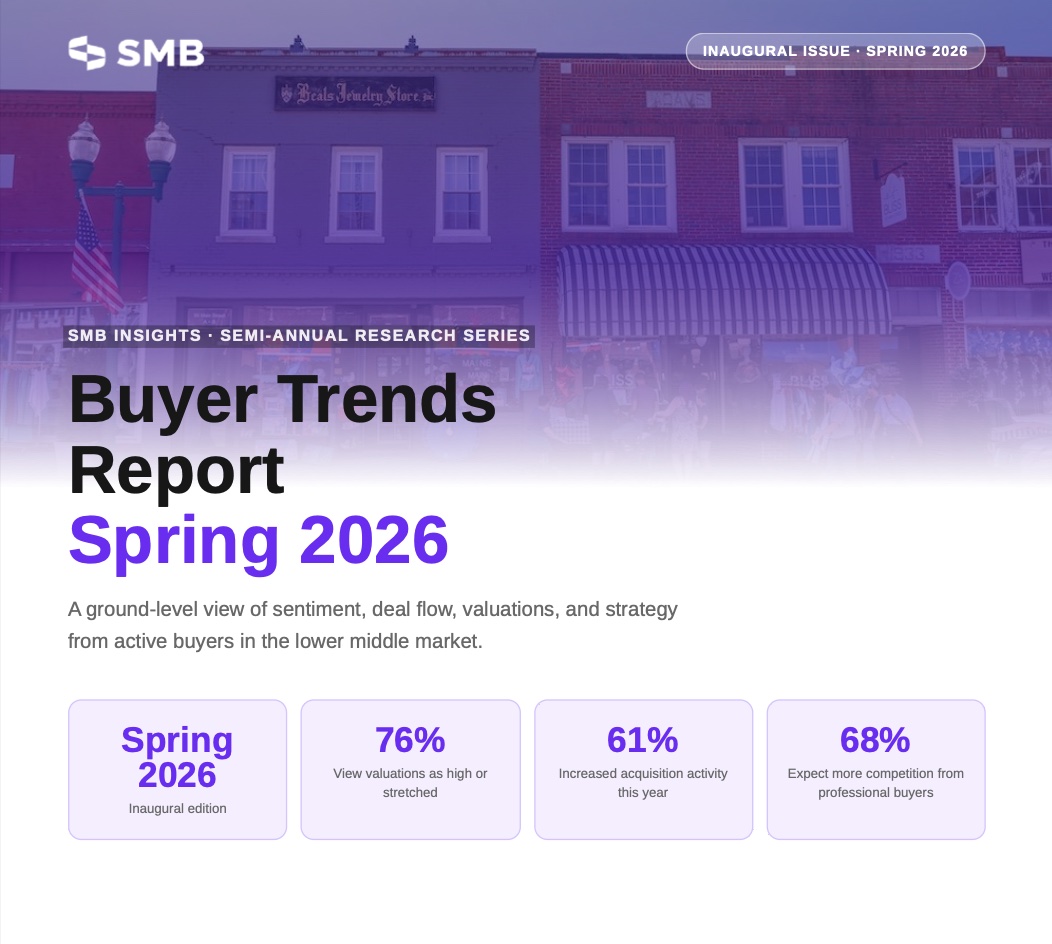
The small business acquisition market isn’t slowing down—but it’s not getting easier either. We asked active buyers what they’re actually seeing, and the answer is clear: opportunity is everywhere, but closing the gap is harder than ever.
Every six months, we ask the people actually doing the work...the buyers actively searching for, evaluating, and acquiring small businesses in the lower middle market to tell us what they are really seeing. Not what the headlines say. Not what the macro data suggests. What is actually happening on the ground, in the deals, in the conversations with brokers and sellers.
Today, we are publishing the inaugural edition of the SMB Insights: Semi-Annual Buyer Trends Report. It is the first of what will be a twice-yearly pulse check on the state of the small business acquisition market, conducted every spring and fall.
The Spring 2026 results are in. And the picture they paint is one of a market that is simultaneously active and frustrated.
Who did we hear from?
The survey captured a broad cross-section of the buyer community who are searching across the $1M–$20M small business revenue segment. Self-funded searchers represent the largest cohort at 49%, followed closely by individual searchers at 39%, together accounting for nearly nine in ten respondents. This composition reflects the dominant buyer profile in the lower middle market today: individual operators or small teams pursuing single-acquisition or portfolio-building strategies without institutional backing.
Notably, 61% of respondents have not yet completed an acquisition, underscoring the high proportion of first-time buyers currently active in the market. These are not passive observers. They are actively building pipelines, attending conferences, signing NDAs, and submitting LOIs. They are in the market, and they are learning fast.
Activity is up, but so is buyer frustration
The most striking finding from this survey is the divergence between sentiment and action. On paper, the macro environment is not particularly favorable for buyers: valuations are stretched, seller expectations are high, and competition from professional capital is increasing. And yet, buyers are not slowing down.
More than half of respondents (54%) report increasing their acquisition activity compared to 12 months ago, with 27% saying activity has "increased a lot." Only 22% report a decrease. Buyers are not waiting for perfect conditions. They are building pipelines, running processes, and staying active in anticipation of the right opportunity.
This is one of the most important signals in the data. It tells us that the demand side of this market is structurally robust, regardless of short-term macro noise. The buyers are there. The capital is there. The appetite is real.
The valuation gap: the market's defining friction point
If there is one theme that runs through every section of this report, it is the valuation gap. The disconnect between what buyers are willing to pay and what sellers expect to receive is the single biggest friction point in the current market, and it is showing up everywhere.
76% of respondents view current valuation levels as either "somewhat high" or "very stretched" relative to the underlying quality of the businesses they are evaluating. Only 22% consider valuations to be about right. And this is not just a perception problem: 61% of buyers report that seller valuation expectations "frequently" or "sometimes" prevent otherwise good deals from happening.
When we asked buyers which macro factors are most impacting their buying plans, the answer was unambiguous. Seller valuation expectations (68%) and the availability of financing (54%) dominate the conversation by a wide margin. Interest rates, while still a concern for 22% of buyers, have receded as the primary worry. The market has largely adjusted to the current rate environment. What it has not adjusted to is the gap between what sellers believe their businesses are worth and what the market will actually bear.
This is where SMB.co's data-backed valuation tool becomes critical. When sellers arrive at the table with a realistic, market-grounded understanding of their business's value, conversations move faster, fewer deals fall apart, and both parties spend less time in unproductive back-and-forth.
Deal flow: a auality problem, not a quantity problem
One of the most revealing findings in the survey concerns deal flow quality. Only 7% of buyers agree that most deals they see today are a good fit for their criteria. A combined 41% disagree or strongly disagree. This is a damning verdict on the quality of available deal flow through traditional channels.
The issue is not a lack of listings. There are more businesses for sale today than at any point in recent memory, driven in part by the demographic wave of retiring baby boomer owners. The issue is a lack of relevant listings. Buyers are spending enormous amounts of time sifting through deals that do not fit their criteria, their geography, their industry focus, or their financial profile.
Despite this quality challenge, buyers are finding meaningful opportunities across multiple channels. Online marketplaces lead at 59%, followed by personal networks (44%), broker relationships (39%), and direct outreach (37%). The near-parity between these channels suggests that the most successful buyers are building diversified pipelines rather than relying on any single approach.
The competitive landscape
The lower middle market is not getting any less crowded. 32% of buyers report that competition has increased versus last year, with 7% describing conditions as "far more competitive." The primary driver is the continued influx of professional buyers: PE funds, ETA vehicles, and family offices that are increasingly targeting the same businesses that individual searchers pursue.
68% of respondents expect this trend to continue over the next 12 months, making the professionalization of Main Street the single most anticipated market development heading into the second half of 2026. For individual and self-funded buyers, this means the window for competing purely on price is narrowing. The buyers who will win are those who differentiate on speed, relationships, and creative deal structuring.
Getting deals done: creative structures are the new normal
In a high-valuation environment where all-cash deals are rare (only 5% of respondents use them), creative deal structuring has become the primary tool for getting transactions across the finish line.
Seller notes (34%) and SBA-backed financing (27%) are the most widely used structures, with earn-outs (22%) playing an increasingly important role in bridging the gap between buyer and seller price expectations. The prevalence of seller notes is particularly telling. When buyers cannot justify a seller's asking price on a cash basis, a seller note effectively allows the seller to bet on themselves, receiving a portion of the purchase price over time, contingent on the business continuing to perform.
On the financing side, the picture is more stable than many expected. Despite elevated interest rates, 68% of buyers report no meaningful change in their ability to access financing compared to 12 months ago. However, 27% say it has become harder or much harder, reflecting tighter underwriting standards now applied by SBA lenders and private credit providers.
What kills deals
When asked which risks they are less willing to accept today, buyers are unambiguous. Weak financials and Quality of Earnings (54%) top the list by a wide margin, followed by key-person and owner dependency (39%) and technology disruption risk (34%). These three risks represent the core due diligence concerns that kill deals in the current environment.
For sellers, this data carries a clear message: the businesses that attract serious buyers and close at strong valuations are those that have clean, auditable financials, operations that can run independently of the owner, and a clear story about how the business will perform in a changing technological landscape. These are not differentiators anymore. They are the price of admission.
Looking ahead: the Silver Tsunami is building
Looking forward, the two trends that buyers expect to define the next 12 months are the continued professionalization of the buyer pool (68%) and the acceleration of retirement-driven exits from baby boomer business owners (46%).
This second trend, often called the Silver Tsunami, represents one of the most significant wealth transfer events in American economic history. An estimated 40% of U.S. small businesses are owned by baby boomers approaching retirement age. As this wave accelerates, the supply of quality businesses coming to market will increase substantially, creating opportunities for prepared buyers who have the tools, the capital, and the relationships to move quickly.
Why does this matter?
If you are a buyer: The market is active, competitive, and increasingly defined by the valuation gap. The buyers who win in this environment are those who build diversified pipelines, master creative deal structuring, and apply rigorous due diligence to the risks that matter most. Speed and relationships matter more than ever.
If you are a seller: The buyers are there, the capital is available, and the demand for quality businesses is strong. But realistic valuation expectations, clean financials, and a business that can operate independently of its owner are no longer differentiators. They are the price of admission for a smooth, successful exit.
If you are an advisor: The data in this report gives you a powerful tool for setting expectations on both sides of the table. Use it.
Download the Full Report
The Spring 2026 SMB Insights Buyer Trends Report is available now as a free download. The full 17-page report includes all survey data, detailed charts, and SMB.co platform insights across every section.
Download the Spring 2026 Buyer Trends Report
The next edition will be published in Fall 2026. To participate in the next survey or learn more about SMB Insights, visit smbinsights.app.
Brit is the Cofounder and CMO of SMB.co, where she leads the company's mission to make small business ownership accessible to everyone. Before cofounding SMB, Brit built and scaled marketing engines at high-growth B2B SaaS companies, but it was her firsthand experience watching small business owners struggle to find buyers and navigate exits that sparked the vision for SMB. She cofounded the company alongside Joe Brown and Mike Hillenmeyer to give independent buyers and sellers the tools, data, and support that were previously only available to private equity firms. A certified leadership coach, Brit is driven by the belief that the next generation of entrepreneurs should have a real shot at owning the businesses that power local communities.
Related Articles



Start building your next deal today.
Join thousands of owners, buyers, and advisors using our platform to discover opportunities and close smoother transactions.